
History of Digital Marketing
For Applying Digital Marketing Course Click Here…
What Is Digital Marketing and Why Did It Begin?
Digital marketing refers to promoting products, services, or brands using digital platforms such as websites, search engines, social media, email, and mobile apps. It began as a response to the rapid growth of the internet and digital technologies, which changed how people searched for information and made purchasing decisions.
Earlier, businesses depended mainly on print, television, and radio advertising. However, as more people started using computers and the internet, companies realized the need to reach customers online in a faster, more targeted, and cost-effective way. This shift marked the beginning of digital marketing.
Key reasons why digital marketing began:
- Growth of the internet and online users
- Need for direct and two-way communication with customers
- Ability to reach a global audience easily
- Cost-effective alternative to traditional marketing
- Better tracking and measurement of marketing results
When Did the Concept of Digital Marketing First Emerge?
Digital marketing first came up in the early 1990s, when personal computers and the internet became more common. This was when businesses began using email and websites to talk to their customers. Before search engines like Yahoo and Google came along, people found information online in other ways. In the late 1990s and early 2000s, search engine marketing, online ads, and email campaigns became more popular. As more and more people around the world started using the internet, digital marketing became a more effective way to promote brands, products, and services than traditional marketing.
How Did Search Engines Transform Digital Marketing Strategies?
Search engines changed digital marketing forever by making it easier for people to find what they need and for businesses to reach the right people at the right time. As Google grew, marketers started to care more about how visible their websites were in search engines than just how many people saw them online. This led to the creation of Search Engine Optimization (SEO), which is the process of making websites more likely to show up in search results.
Search engines also came up with paid advertising models that let businesses show ads based on keywords and what users want. This change made marketing more focused, easier to track, and less expensive. This made search engines a key part of digital marketing plans, bringing in traffic, leads, and sales for businesses all over the world.
How Did Social Media Marketing Start?
In the early 2000s, social media marketing began when social networking sites like Facebook and Twitter let people connect and share content online. MySpace and LinkedIn were two of the first platforms that let brands talk to their audiences directly in new ways. Facebook was the real game-changer because it let businesses make brand pages and run ads that were aimed at specific groups of people. Over time, sites like Twitter and Instagram made it even easier to market. Social media marketing changed how brands talk to customers by making it more interactive, personal, and focused on the customer.
How Did Google Revolutionize Online Advertising?
Google revolutionized the way online ads work by introducing smarter, more targeted, and performance-based models. Before Google, most online ads were just banners that were more about getting noticed than getting results. Google changed this by linking ads directly to what people were looking for.
With the launch of Google Ads (formerly AdWords), businesses could show ads based on specific keywords, ensuring that ads reached people who were actively searching for them. This made ads more useful for people and more profitable for businesses.
Key ways Google transformed online advertising:
- Introduced keyword-based advertising
- Enabled pay-per-click (PPC), where advertisers pay only for results
- Offered precise audience targeting and location-based ads
- Provided detailed analytics to measure performance
- Made online advertising affordable for small and large businesses
- This innovation reshaped digital marketing and set global advertising standards.
How Did Mobile Marketing Become a Game Changer?
The fast rise in smartphone use and mobile internet access made mobile marketing a game-changer. Businesses started to focus on reaching customers through mobile-friendly websites, apps, and messages as people spent more time on their phones. Smartphones and platforms like Android and iOS made it easier and faster to connect with people online. Brands could reach users at any time and from any place thanks to features like SMS marketing, push notifications, location-based ads, and mobile apps. Mobile marketing is one of the most powerful tools in digital marketing today because it lets people interact with businesses directly and in real time.
Types of Digital Marketing:
Digital marketing includes various methods that help businesses reach and engage customers online. Below are the major types of digital marketing, explained in detail:
Search Engine Optimization (SEO)
SEO focuses on improving a website’s visibility on search engines like Google. It involves optimizing content, keywords, website structure, and backlinks so that a website ranks higher in organic (unpaid) search results. SEO helps drive long-term traffic and builds credibility.
Search Engine Marketing (SEM)
SEM involves paid advertising on search engines. Businesses bid on keywords to show ads at the top of search results. Pay-Per-Click (PPC) is the most common SEM model, where advertisers pay only when users click on their ads.
Social Media Marketing (SMM)
This type uses social media platforms such as Facebook, Instagram, and LinkedIn to promote brands. It includes organic posts, paid ads, stories, and influencer collaborations to build engagement and brand awareness.
Content Marketing
Content marketing focuses on creating valuable and informative content such as blogs, articles, videos, infographics, and ebooks. The goal is to attract, educate, and retain customers rather than directly selling products.
Email Marketing
Email marketing involves sending personalized messages, newsletters, offers, and updates directly to users’ inboxes. It is cost-effective and helps nurture leads, improve customer relationships, and increase repeat sales.
Affiliate Marketing
In affiliate marketing, businesses partner with affiliates who promote products or services. Affiliates earn a commission for every sale or lead generated through their referral links.
Influencer Marketing
This type uses influencers or content creators with a loyal audience to promote products. Influencer marketing is especially popular on platforms like YouTube and Instagram, as it builds trust through authentic recommendations.
Mobile Marketing
Mobile marketing targets users through smartphones using SMS, mobile apps, push notifications, and mobile-friendly ads. It allows real-time and location-based communication with customers.
Video Marketing
Video marketing uses videos to promote brands, explain products, or educate customers. It is highly engaging and widely used on social media and video platforms.
Online Reputation Management (ORM)
ORM focuses on managing online reviews, ratings, and brand mentions. It helps maintain a positive brand image and builds customer trust.
What Is Digital Marketing History?
The history of digital marketing shows how businesses have changed the way they use digital technologies to advertise their goods and services. It started in the early 1990s, when the internet became open to everyone. Companies began to make websites and use email to talk to customers during this time. These early attempts were the start of digital marketing.
The first clickable banner ad came out in 1994, which made it possible to advertise online. Search engines like Yahoo and later Google changed how people found information as more people went online. This led to the growth of paid search advertising and Search Engine Optimization (SEO), which made marketing more focused and easier to track.
Social media sites became more popular in the early 2000s. Brands could talk to users directly on sites like LinkedIn, Facebook, and later Instagram. Social media marketing changed digital marketing from one-way advertising to two-way communication, with an emphasis on building relationships and getting people involved.
Mobile marketing became more important as smartphones became more popular in the 2010s. Companies started making their websites work better on mobile devices and using SMS, apps, and location-based ads to reach customers in real time. Content marketing, video marketing, and email marketing all became important ways to teach and care for audiences at the same time.
Digital marketing has come a long way in the last few years, thanks to the use of data analytics, AI, and automation. Marketers can now look at how users act, tailor content to them, and run very targeted campaigns on many platforms. Digital marketing is always changing to keep up with new technologies and changing consumer behavior. This makes it one of the most powerful and flexible forms of marketing in the modern world.
How Has Artificial Intelligence Changed Digital Marketing Today?
AI has improved digital marketing a lot by making strategies smarter, faster, and more personalized for each person. Companies can use AI to analyze a lot of data to learn about their customers’ preferences and behaviors. Google and Meta use AI to make campaigns work better, reach the right people, and make ads more effective. AI chatbots help customers right away, and tools that suggest content and automate emails make the experience even better. In general, AI has helped marketers send personalized messages, work faster, and get better results in the digital world, which is very competitive these days.
Evolution of Digital Marketing – The Timeline:
The evolution of digital marketing can be clearly understood by dividing it into key phases based on technological growth and changing consumer behavior. From basic internet usage in the 1990s to today’s AI-driven marketing, each era has played a major role in shaping modern digital strategies.
The 90s: The Beginning of Digital Marketing
The 1990s marked the birth of digital marketing with the rise of the internet and personal computers. During this time, marketing was mainly informational rather than interactive. Businesses started creating simple websites to showcase their products and services. Email marketing also emerged as one of the earliest digital marketing tools, allowing companies to communicate directly with customers.
In 1994, the first clickable banner advertisement was launched, opening the door to online advertising. Search engines like Yahoo helped users find information online, though competition was low and SEO was still basic. Digital marketing in the 90s focused more on online presence than strategy, but it laid the foundation for future growth.
The Millennial Generation: Growth and Engagement (2000–2010)
The early 2000s saw rapid digital marketing expansion driven by the millennial generation. Internet usage increased significantly, and users began spending more time online. Search engines evolved, and Google revolutionized digital marketing with keyword-based advertising and Search Engine Optimization (SEO).
This era also witnessed the rise of social media platforms. LinkedIn connected professionals, while Facebook introduced social interaction on a massive scale. Brands started building online communities, focusing on engagement rather than just promotion.
Email marketing became more structured, content marketing gained importance, and businesses began tracking performance through analytics. Digital marketing shifted from static advertising to interactive and data-driven strategies during this phase.
The Mobile Era: Anytime, Anywhere Marketing (2010–2018)
The mobile era transformed digital marketing completely. With the widespread adoption of smartphones and mobile internet, consumers started accessing content anytime and anywhere. Platforms powered by Android and Apple changed how users interacted with brands.
Businesses optimized websites for mobile devices and adopted mobile-first strategies. SMS marketing, mobile apps, push notifications, and location-based advertising became popular. Social media platforms like Instagram and video platforms such as YouTube dominated user attention, making visual and video marketing essential.
Consumers now expect fast-loading websites, personalized messages, and seamless mobile experiences. This era pushed marketers to focus on user experience, responsiveness, and real-time engagement.
The Present: Data, AI, and Personalization (2019–Today)
In the present era, digital marketing is more advanced, intelligent, and customer-centric than ever before. Technologies like Artificial Intelligence (AI), machine learning, and automation play a crucial role in shaping marketing strategies. Platforms such as Google and Meta use AI to optimize ads, predict user behavior, and improve targeting accuracy.
Personalization has become the core of digital marketing. Brands now deliver customized content, product recommendations, and ads based on user preferences and behavior. Chatbots provide instant support, while marketing automation tools streamline email campaigns and lead nurturing.
Data analytics helps businesses measure performance, understand customer journeys, and make informed decisions. Voice search, influencer marketing, short-form videos, and omnichannel strategies are shaping the future of digital marketing.
What Are the 5 Ds of Digital Marketing?
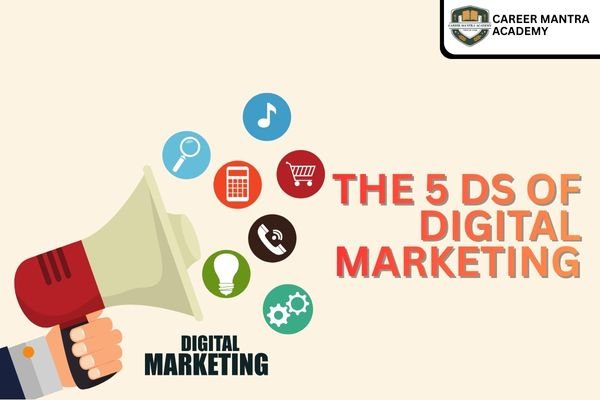
The 5 Ds of Digital Marketing explain how businesses connect with customers in the digital world. These five elements help marketers understand where audiences are present and how to engage them effectively.
1. Digital Devices
Digital marketing begins with the devices people use to access online content. These include smartphones, tablets, laptops, desktops, smart TVs, and even wearable devices. Today, most users interact with brands through mobile phones, making mobile-friendly websites and apps essential. Marketers must ensure their content is responsive, fast-loading, and user-friendly across all devices to provide a seamless experience.
2. Digital Platforms
Digital platforms are the online environments where users spend their time. These include search engines, social media platforms, websites, mobile apps, and email platforms. Examples include Google, Facebook, Instagram, and YouTube. Businesses use these platforms to publish content, run advertisements, and engage with audiences. Choosing the right platform depends on the target audience and marketing goals.
3. Digital Media
Digital media refers to the communication channels used to reach users online. It includes:
- Paid media (search ads, social media ads)
- Owned media (company websites, blogs, email lists)
- Earned media (reviews, shares, mentions)
Digital media helps brands build awareness, generate leads, and influence purchasing decisions through multiple touchpoints.
4. Digital Data
Digital data is the information collected from user interactions online. This includes website traffic, click behavior, search history, demographics, and engagement metrics. Data allows marketers to understand customer preferences, measure campaign performance, and improve strategies. With analytics tools, businesses can make data-driven decisions, personalize content, and optimize marketing efforts for better results.
5. Digital Technology
Digital technology includes the tools and software that power digital marketing activities. These include analytics tools, customer relationship management (CRM) systems, marketing automation, artificial intelligence, and chatbots. Advanced technologies help automate tasks, improve targeting, enhance customer experience, and increase marketing efficiency.
Why choose Career Mantra Academy for the Digital Marketing Course?
Career Mantra Academy is the best choice because it offers hands-on, skill-based digital marketing training that is tailored to meet the needs of the industry and can be used in the real world. Their teachers are all experienced, and their courses mix hands-on learning with modules that focus on careers. You also get flexible online classes and help with things like finding a job, getting an internship, and making connections that can help you get your career off to a good start. It’s a good choice for both beginners and people who want to change careers because it has low prices and focuses on building confidence and professional skills.
Conclusion.
The history of digital marketing shows how marketing has changed as technology and how people act as customers have changed. Digital marketing has changed a lot since the 1990s, when it was just email campaigns and simple websites. AI and data have made it more focused, interactive, and easy to measure. By understanding this journey, students and businesses can better adapt to what’s going on now and get ready for what’s to come. With the right information, tools, and help from places like Career Mantra Academy, anyone can learn how to do digital marketing well and get ahead in this field that changes quickly.
FAQs
Who is the founder of digital marketing?
Digital marketing does not have a single founder, as it evolved gradually with the internet. However, Jeffrey Rayport is often credited as one of the pioneers for introducing the concept of online marketing in the 1990s, laying the foundation for modern digital marketing strategies.
What are the 7 types of digital marketing?
1. Search Engine Optimization (SEO) – Improving website visibility on search engines.
2. Search Engine Marketing (SEM) – Paid advertising on search engines.
3. Social Media Marketing (SMM) – Promoting brands on social platforms.
4. Content Marketing – Creating valuable content to attract and engage users.
5. Email Marketing – Direct communication via emails.
6. Affiliate Marketing – Partner-driven promotions.
7. Influencer Marketing – Collaborating with influencers to reach audiences.
How do I start digital marketing?
To start digital marketing, first learn the basics of SEO, social media, content, email, and paid ads. Create your own website or blog to practice. Take online courses or certifications to build skills. Gain experience through internships, projects, or freelance work. Finally, stay updated with trends and analyze results to improve strategies continuously.
What are the 5 basic digital skills?
1. Digital Literacy – Understanding and using digital devices effectively.
2. Online Communication – Email, messaging, and social media interaction.
3. Content Creation – Writing, designing, and producing digital content.
4. Data Management – Handling, analyzing, and interpreting digital data.
5. Cybersecurity Awareness – Protecting information and understanding online safety.
What is the 3 3 3 rule in marketing?
The 3-3-3 rule is a marketing principle focused on simplicity and engagement. It suggests:
Keep messages under 3 sentences.
Limit key points to 3 ideas.
Deliver content in under 3 minutes.
This ensures communication is clear, concise, and easy for audiences to remember and act upon.