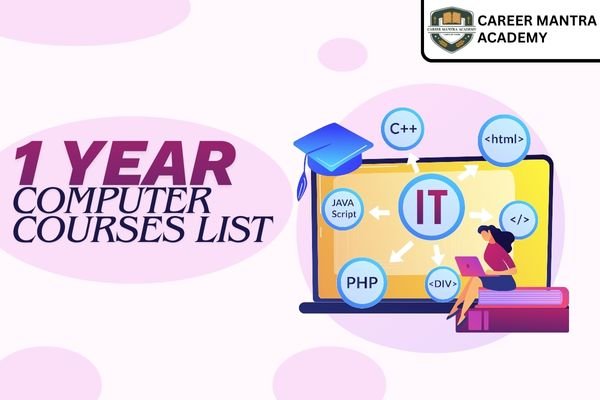
1 Year Computer Courses List
For Applying Computer Course Click Here…
What Are Computer Courses and Why Are They Popular?
Computer courses are structured lessons that teach people and students important digital skills. These classes cover a lot of ground, including programming, graphic design, web development, data analytics, digital marketing, accounting software, and cybersecurity. Depending on the learner’s goals, they can be short-term (3–6 months), long-term (1 year), diploma-based, or certification-based.
Because technology is so important to almost every field, computer courses are very popular in today’s fast-paced digital world. Every field, from business to education to healthcare to banking to entertainment, needs skilled computer workers. These classes not only teach you more about technology, but they also help you think outside the box, solve problems, and talk to people.
Why Are Computer Courses Popular?
- High Demand for Digital Skills: Companies need employees who understand technology, software tools, and online systems.
- Better Job Opportunities: Computer-skilled candidates get priority in IT and non-IT fields.
- Career Flexibility: You can switch careers easily—like from marketing to digital marketing or from accounting to data analytics.
- Work-from-Home Options: Many tech-related roles allow remote work, freelancing, and online jobs.
- Affordable & Easily Accessible: Courses are available online and offline at budget-friendly prices.
What Are the Benefits of Doing a Computer Course?
There are many benefits to taking computer classes for students, job seekers, and people who already work. These classes help people keep up with the fast changes in technology that are happening in every field. They also help people learn new skills and get better job opportunities. The benefits of taking a basic computer course or an advanced specialization last a long time and are very useful.
Key Benefits of Doing a Computer Course:
1. Better Job Opportunities
Computer skills are essential in almost every sector—IT companies, banking, finance, education, marketing, healthcare, and more. Completing a computer course increases your chances of getting hired faster with better job roles.
2. Higher Salary Potential
People with strong computer knowledge are often paid more than those with basic skills. Technical fields like programming, digital marketing, data analytics, AI, and cybersecurity offer excellent salary growth.
3. Increased Productivity and Efficiency
Computer courses help you learn tools like Excel, Tally, design software, or coding platforms. These tools boost your speed, accuracy, and overall productivity in any job role.
4. Career Flexibility
With computer certifications, you can switch career paths easily. For example:
- From accounting to data analytics
- From marketing to digital marketing
- From graduation to IT or software development
5. Freelancing and Work-from-Home Opportunities
Computer-based jobs such as graphic design, digital marketing, content writing, web development, and data entry can be done from home. This allows flexible working hours and additional income sources.
6. Boosts Creativity and Problem-Solving Skills
Courses like graphic designing, animation, UI/UX, or coding improve your creativity and analytical thinking. You learn how to solve problems logically using digital tools.
7. Helps in Business Growth
Business owners who learn computer skills can manage accounts, design marketing materials, handle social media, and analyze data to grow their business effectively.
8. Essential for Higher Education
Many advanced degrees (MBA, MCA, Engineering, etc.) require strong computer knowledge. Learning early gives you an advantage in future studies.
9. Makes You Future-Ready
Technology is evolving quickly—AI, automation, cloud computing, and cybersecurity are the future. Computer courses prepare you for upcoming trends and help secure your career.
10. Affordable and Easy to Learn
Most computer courses are affordable and available both online and offline. Even beginners can start with basic courses and gradually move to advanced ones.
Which Are the Top Computer Courses for Students and Professionals?
Computer courses have become one of the most reliable ways to build a strong career in today’s digital world. Whether you are a student looking for foundational skills or a working professional aiming to upgrade your knowledge, there is a wide variety of courses suitable for everyone. These courses help you stay competitive, improve earning potential, and open doors to job opportunities across multiple industries.
Below is a detailed overview of the top computer courses that students and professionals can pursue to boost their career growth.
1. Diploma in Computer Applications (DCA)
DCA is one of the most popular entry-level computer courses for beginners. It covers basic to intermediate computer concepts, making it ideal for students after 10th or 12th grade and working individuals who want to improve their computer literacy.
Key Highlights
- Basics of computer systems
- MS Office (Word, Excel, PowerPoint)
- Internet and networking basics
- Introduction to programming
- Basic accounting software
This course offers job roles such as computer operator, office assistant, data entry operator, and support staff in small to medium offices.
2. Diploma in Information Technology (DIT)
The DIT course is slightly more advanced than DCA. It focuses on the overall use of IT across different industries.
What You Learn
- IT systems
- Website basics
- Software tools
- Basic coding
- Computer maintenance
Students who take this course can work in IT support, office administration, customer support, and data management profiles.
3. Advanced Diploma in Computer Applications (ADCA)
ADCA is a one-year, advanced-level program that offers deeper knowledge of computer applications. It covers a combination of programming, office tools, design basics, and software management.
Course Topics
- Advance MS Office
- Tally and GST
- HTML, CSS, and basic programming
- Computer networks
- Database management
ADCA provides job opportunities in IT support, data management, accounting support, and junior web or software development roles.
4. Web Designing & Development Course
This course is perfect for creative students who want to build and design websites. It includes everything from layout design to frontend and backend development.
Skills You Learn
- HTML, CSS, JavaScript
- WordPress development
- Responsive design UI/UX basics
- PHP, MySQL basics
Web designers can work as freelancers, join agencies, or build websites for businesses. The demand for web development continues to grow with the expansion of online platforms.
5. Graphic Designing Course
Graphic design is one of the most trending creative fields. Through this course, students learn how to create visual content for brands, ads, social media, and websites.
Tools Covered
- Adobe Photoshop
- Illustrator
- CorelDRAW
- InDesign
- Canva
Graphic designers can work in digital marketing agencies, printing companies, advertising firms, or as freelancers.
6. Digital Marketing Course
Digital marketing is one of the fastest-growing computer courses. It is ideal for students, professionals, business owners, and freelancers.
Main Modules
- SEO (Search Engine Optimization)
- Social Media Marketing
- Google Ads
- Email Marketing
- Content Writing
- Analytics
Digital marketing experts are in high demand across all industries because businesses rely heavily on online promotion and branding.
7. Software Programming Course (Java, Python, C++)
Programming is the backbone of the IT industry. Learning languages like Java, Python, and C++ helps students build applications, software, and AI solutions.
Why Learn Programming?
- High-paying jobs
- Opportunities in MNCs
- Work in software development, app development, and automation
- Strong logical and problem-solving skills development
These courses open career paths such as software developer, backend developer, and application engineer.
8. Full-Stack Development Course
Full-stack developers handle both the front-end (client-side) and back-end (server-side) of websites or applications. It is one of the most in-demand and high-paying fields.
What You Learn
- HTML, CSS, JavaScript
- React or Angular
- Node.js
- MongoDB / MySQL
- API development
Full-stack developers can work in multinational companies, startups, and tech consulting firms.
9. Cyber Security & Ethical Hacking Course
As digital activities increase, cyber threats are also rising. Cybersecurity courses train students to protect systems from hacking, malware, and data breaches.
Key Modules
- Network security
- Ethical hacking tools
- System protection
- Data security
- Penetration testing
Cybersecurity professionals are highly valued in banking, IT, government sectors, and large corporations.
10. Data Analytics & Business Intelligence Course
Data analytics is the future of business decision-making. This course is ideal for graduates and professionals who want to enter the data-driven job market.
What You Learn
- Excel advanced
- SQL
- Power BI
- Python basics
- Data visualization
Data analysts help companies understand trends, make decisions, and improve business performance. The demand for data experts is increasing rapidly.
11. Tally with GST & Accounting Course
This course is perfect for students interested in accounting, banking, and finance. Tally is widely used for maintaining business finances.
Topics Covered
- Tally ERP
- GST filing
- Billing and inventory
- Payroll management
- Financial reports
Tally professionals find roles in accounting firms, small businesses, CA offices, and finance departments.
12. Computer Hardware & Networking Course
This course is ideal for students who want to work in technical support, system maintenance, or network administration.
What You Learn
- Computer assembly
- System troubleshooting
- Networking basics
- Router configuration
- Security protocols
There is continuous demand for hardware and networking technicians in IT companies, offices, and service centers.
13. UI/UX Designing Course
UI/UX designing focuses on enhancing user experience by creating attractive, user-friendly digital layouts.
Skills Covered
- Wireframing
- Prototyping
- User research
- Interface design
- Figma, Adobe XD
UI/UX designers work with app developers, web agencies, and tech companies to improve product usability.
14. Animation & VFX Course
Animation and VFX courses are ideal for students who want careers in entertainment, advertising, gaming, and filmmaking.
Topics Include
- 2D & 3D animation
- Motion graphics
- Visual effects
- Character modeling
- Film compositing
VFX artists are in high demand in media companies, studios, and YouTube content creation.
15. Mobile App Development Course
With millions of apps on Android and iOS, mobile app development is one of the hottest career fields.
What You Learn
- Android development with Java/Kotlin
- iOS development with Swift
- UI/UX for mobile apps
- API integration
- App testing
App developers can work in tech companies or become independent app creators.
Who Is Eligible for Computer Courses?
Computer courses are designed to be accessible for students, job seekers, and professionals from different educational backgrounds. Eligibility depends on the type of course, but most programs allow beginners to start easily.
Eligibility Criteria for Computer Courses
- Students After 10th & 12th: Basic and diploma-level computer courses like DCA, DIT, ADCA, Tally, and graphic designing are open to school students.
- Graduates from Any Stream: Students who completed BA, B.Com, B.Sc, BBA, etc., can join advanced courses such as digital marketing, UI/UX, web development, data analytics, and programming.
- Working Professionals: Anyone looking to upgrade skills or switch careers can enroll in short-term or specialized programs.
- No Technical Background Required: Many courses do not require prior computer knowledge.
- Basic English & Computer Knowledge Helpful: Good for understanding software tools and online learning.

What Skills Can You Learn from These Courses?
Computer courses help students and professionals build strong technical, creative, and analytical skills needed in today’s digital world. Depending on the course you choose—whether it’s programming, designing, marketing, or accounting—you gain practical abilities that improve job performance and career growth.
Below are the key skills you can learn from various computer courses:
Technical & Software Skills
- Basic Computer Operations: MS Office, internet usage, and file management.
- Programming Skills: Java, Python, C++, database handling, logic building.
- Web Development Skills: HTML, CSS, JavaScript, front-end and back-end coding.
- App Development Skills: Android/iOS development, UI components, API integration.
- Networking & Hardware Skills: System troubleshooting, network setup, and maintenance.
- Cybersecurity Skills: Ethical hacking, data protection, security testing.
- Data Analytics Skills: Excel advanced, Power BI, SQL, data visualization.
Creative & Design Skills
- Graphic Designing: Photoshop, Illustrator, CorelDRAW, and layout creation.
- UI/UX Skills: Wireframing, prototyping, user research, and interface design.
- Animation & VFX: 2D/3D animation, motion graphics, visual effects.
Business & Marketing Skills
- Digital Marketing: SEO, social media marketing, Google Ads, and content creation.
- Accounting Skills: Tally ERP, GST filing, inventory, and payroll management.
- Business Intelligence: Insights, dashboards, performance reporting.
Soft Skills
- Problem-Solving
- Creativity
- Analytical Thinking
- Time Management
How Much Salary Can You Expect After These Courses?
| Course Name | Job Roles | Average Starting Salary (Per Month) |
| DCA (Diploma in Computer Applications) | Computer Operator, Office Assistant | ₹12,000 – ₹18,000 |
| DIT (Diploma in Information Technology) | IT Support, Technical Assistant | ₹15,000 – ₹22,000 |
| ADCA (Advanced Diploma in Computer Applications) | Data Entry Executive, Junior Developer | ₹15,000 – ₹25,000 |
| Web Designing & Development | Web Designer, Front-End Developer | ₹20,000 – ₹40,000 |
| Graphic Designing | Graphic Designer, Creative Executive | ₹18,000 – ₹35,000 |
| Digital Marketing | SEO Executive, Social Media Manager | ₹20,000 – ₹45,000 |
| Programming (Java/Python/C++) | Software Developer, Backend Developer | ₹25,000 – ₹60,000 |
| Full-Stack Development | Full-Stack Developer | ₹30,000 – ₹70,000 |
| Cyber Security & Ethical Hacking | Security Analyst, Ethical Hacker | ₹30,000 – ₹80,000 |
| Data Analytics & BI | Data Analyst, BI Analyst | ₹25,000 – ₹60,000 |
| Tally with GST & Accounting | Accountant, GST Executive | ₹15,000 – ₹30,000 |
| Hardware & Networking | Network Technician, IT Support Engineer | ₹15,000 – ₹28,000 |
| UI/UX Designing | UI/UX Designer | ₹25,000 – ₹50,000 |
| Animation & VFX | Animator, VFX Artist | ₹20,000 – ₹45,000 |
| Mobile App Development | App Developer (Android/iOS) | ₹30,000 – ₹70,000 |

What Career Opportunities Are Available After Completing Computer Courses?
| Course Name | Career Opportunities / Job Roles |
| DCA (Diploma in Computer Applications) | Computer Operator, Office Assistant, Data Entry Operator |
| DIT (Diploma in Information Technology) | IT Support Staff, Technical Assistant, System Coordinator |
| ADCA (Advanced Diploma in Computer Applications) | Junior Web Developer, Office Executive, Database Assistant |
| Web Designing & Development | Web Designer, Front-End Developer, WordPress Developer |
| Graphic Designing | Graphic Designer, Creative Artist, Social Media Designer |
| Digital Marketing | SEO Executive, Social Media Manager, PPC Specialist, Content Marketer |
| Programming (Java, Python, C++) | Software Developer, Backend Developer, Automation Engineer |
| Full-Stack Development | Full-Stack Developer, Front-End Developer, Back-End Developer |
| Cyber Security & Ethical Hacking | Cyber Security Analyst, Ethical Hacker, Penetration Tester |
| Data Analytics & Business Intelligence | Data Analyst, BI Analyst, Reporting Analyst |
| Tally with GST & Accounting | Accountant, GST Executive, Billing Executive |
| Hardware & Networking | Network Technician, IT Support Engineer, System Administrator |
| UI/UX Designing | UI Designer, UX Researcher, Product Designer |
| Animation & VFX | Animator, Motion Graphics Artist, VFX Compositor |
| Mobile App Development | Android Developer, iOS Developer, Mobile App Tester |
Which Computer Course Is Best for Getting a Job?
It depends on what you want to do with your life, but some computer courses are more in demand and will help you find a job faster. Some of the most job-oriented options are Full-Stack Development, Digital Marketing, Data Analytics, Cyber Security, UI/UX Designing, and Programming (Java/Python). These classes teach you skills that companies need right away, which means you can get a job faster and earn more money. Tally with GST is great for business students, and Graphic Designing or Animation is great for creative students. In general, technical courses like full-stack development and cybersecurity give you the best chance of getting a job in today’s digital market.
How Can You Choose the Right Computer Course for Your Career?
The best computer course for you will depend on your interests, strengths, and career goals. First, figure out if you want to learn technical, creative, or business skills. Look into the job market, pay, and skills needed for each field. DCA/ADCA is a good place for beginners to start, and full-stack development, data analytics, cybersecurity, or digital marketing are good options for people who want to make a career out of it. Look into the course length, the syllabus, the hands-on training, and the help with finding a job.
Think about how you learn best, whether it’s online or in person. Always pick a class that will help you reach your long-term goals and give you skills you can use in the real world to help you build a strong and successful career.

Why choose Career Mantra Academy for a Computer Course?
Career Mantra Academy is a renowned training center that offers computer courses tailored to the industry, incorporating hands-on learning. Expert trainers, up-to-date syllabi, and training based on real projects all help students develop their skills. The academy has low fees, flexible class times, one-on-one help, and help with finding a job. Career Mantra Academy can help you build confidence and secure better job opportunities in today’s digital world, whether you are a beginner or an experienced professional.
Conclusion.
Computer courses have become essential for students and professionals who want to build a strong, future-ready career. Whether your goal is to learn basic computer skills, enter the IT industry, explore creative fields, or upgrade your professional abilities, there is a suitable course for everyone. From programming and web development to digital marketing, data analytics, and design, these courses open doors to high-paying and flexible job opportunities. By choosing the right training and staying updated with technology, you can secure long-term career growth. Career Mantra Academy further enhances this journey with quality training and placement support.
FAQs
Which computer course is best for 1 year?
The best 1-year computer courses for high-demand jobs are Full-Stack Development, Data Analytics, Cybersecurity, Digital Marketing, and ADCA. Beginners can start with ADCA, while tech-focused learners should choose programming, full-stack, or data analytics for better careers.
Which computer course is best?
The best computer course depends on your career goals. For tech careers, Full-Stack Development, Data Analytics, Cybersecurity, and Programming (Java/Python/C++) are ideal. For creative fields, UI/UX Designing, Graphic Designing, and Digital Marketing work well. Beginners or office-focused learners can start with ADCA or DCA to build foundational skills and secure entry-level jobs.
What computer course is easy?
The easiest computer courses are DCA (Diploma in Computer Applications), ADCA (Advanced Diploma in Computer Applications), Tally with GST, and basic MS Office courses. They require no prior technical knowledge and are beginner-friendly, suitable for office and administrative jobs.
Difference Between Python and C++?
Python and C++ are both popular programming languages, but they differ significantly. Python is an interpreted, high-level language with simple syntax, making it beginner-friendly and ideal for web development, data science, AI, and automation. It uses dynamic typing and automatic memory management, allowing faster prototyping. C++, on the other hand, is a compiled, high-performance language with complex syntax and manual memory management. It is best for game development, system software, and applications requiring speed and efficiency. While Python emphasizes ease of use and readability, C++ focuses on speed, control, and advanced programming features.